Introducing AnyDoc and pdf-inspector: Firecrawl's open-source document parsing stack
 Eric Ciarla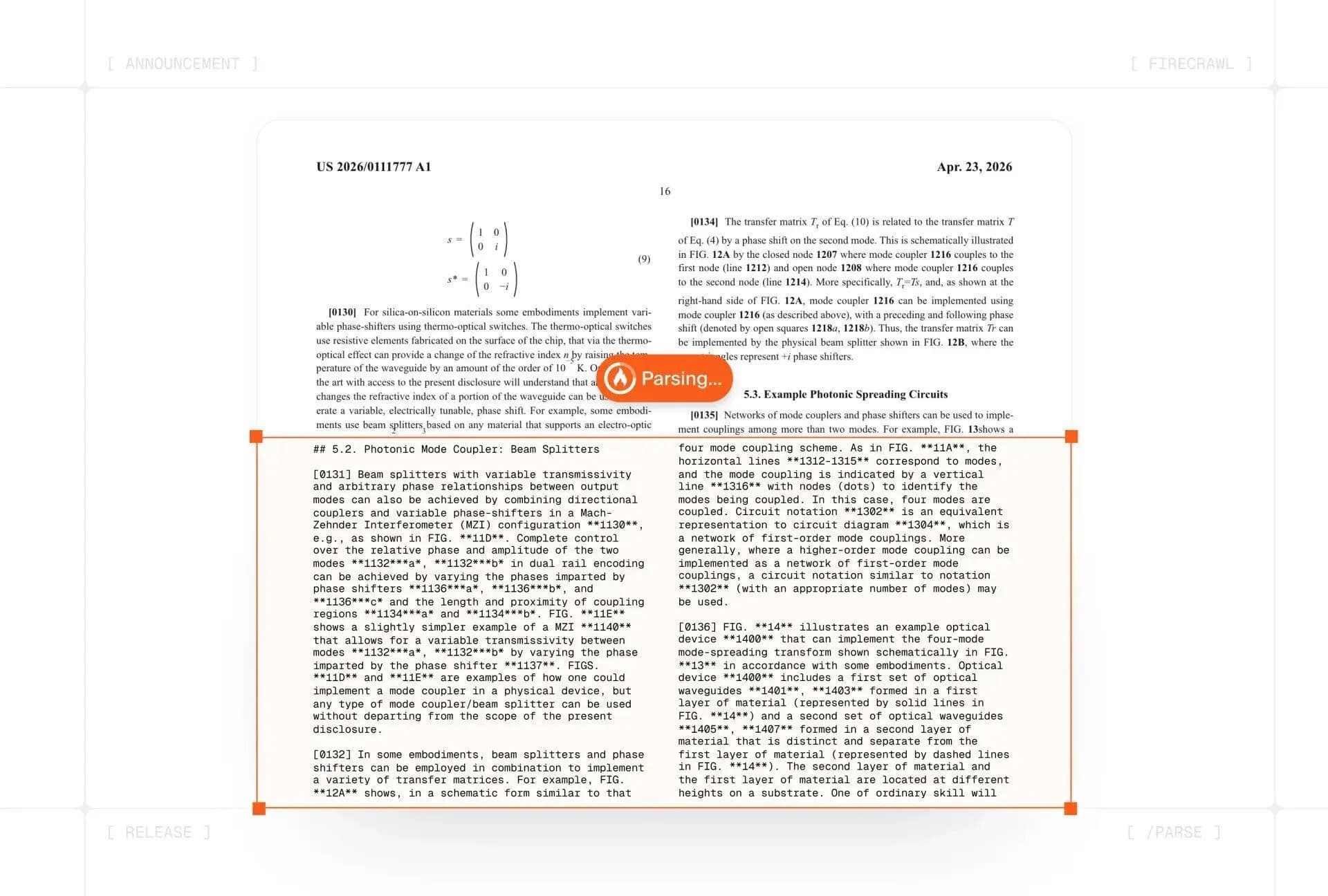
No single library reliably converts every common document format to clean markdown. You end up stitching four or five tools together, each with its own dependencies, output shape, and failure modes.
So we built two Firecrawl projects to solve it: pdf-inspector for PDFs, and AnyDoc for everything else. Two Firecrawl open-source Rust libraries, one lineage, deliberately separate repos. Between them they cover the document formats a real AI pipeline actually sees, with no API key and no system dependencies.
P.S. Both libraries already power document processing in Firecrawl's /parse and /scrape endpoints. If you use those, you're already using them.
Firecrawl pdf-inspector
What is Firecrawl pdf-inspector
pdf-inspector is a from-scratch Rust library for PDFs, with 13k GitHub stars on the repo at time of writing. It reads a PDF's internal structure (font encodings, text operators, image coverage) in milliseconds, without rendering anything, and decides per page whether the content is text-based or needs OCR.
- Text-based pages get native extraction directly, with reading order preserved.
- Scanned or image-heavy pages are flagged with the reason, so a vision pipeline can pick them up.
For a fully text-based PDF, pdf-inspector alone is the entire pipeline. For mixed documents, it's the smart router that decides what actually needs a GPU.
Why it matters on its own
Most PDF pipelines make the same wrong bet: treat every page as if it might be scanned, so route everything through OCR. That's slow, expensive, and often less accurate than the native text that was sitting in the PDF the whole time.
pdf-inspector fixes the routing layer:
- Per-page classification. Analyzes internal structure only. No rendering, no GPU, milliseconds per page.
- Native text extraction. Pulls text directly from text-based pages with reading order intact.
- Clean handoff for the rest. For scanned pages, it hands back the page reference and the reason, so an OCR pipeline can do the heavy lifting only where it's needed.
That routing layer is what makes Fire-PDF, Firecrawl's hosted PDF parsing engine, 3.5x to 5x faster than the previous pipeline: for a 200-page report where 150 pages are pure text, 150 pages skip GPU entirely.
How to use it
Add pdf-inspector to your Rust project directly from the repo. The README covers the classifier and native-extraction APIs, plus the reproducible-results branch if you want to benchmark it against your own PDFs.
Or don't integrate it directly at all: send PDFs to Firecrawl's /parse or /scrape and they go through pdf-inspector (and Fire-PDF for the scanned pages) automatically.
Firecrawl AnyDoc
What is Firecrawl AnyDoc
AnyDoc is the other half of the stack, also a from-scratch Rust library, also markdown out. It converts documents with a single call:
anydoc::to_markdown("file.docx")It supports 14 formats in one binary:
- docx
- doc
- docm
- xlsx
- xls
- xlsm
- pptx
- ppt
- rtf
- odt
- ods
- odp
- epub
- csv
No API key. No system dependencies. Nothing to install alongside it.
It also converts text-based PDFs directly, running them through pdf-inspector under the hood, so a single AnyDoc call now covers PDFs alongside the 14 formats above.
Why it matters
No single existing library reliably covers every common document format. Each one handles a subset, and the formats it doesn't cover become someone else's dependency, with different output, different failure modes, and often much slower conversions. AnyDoc handles all 14 in one dependency-free library.
Who feels this most: the engineer whose users upload "whatever they have": a .docx contract, an .xls export from 2009, a pitch deck, an .epub. Today, getting usable text out of all of it is a plumbing project. AnyDoc is the part that stops being plumbing.
It's also quickly become a dev favorite. Here's Garry Tan on it:
Here's Nick, Firecrawl's Co-founder and CTO, on how AnyDoc is different from pdf-inspector:
How it compares
We benchmarked AnyDoc against six other converters on 100 real-world documents spanning all 14 formats.
- Coverage: 14 of 14. AnyDoc is the only library in the benchmark that parses every format. The nearest alternative, LibreOffice, covers 12 of 14. Every other option covers a subset, which is exactly why teams end up stitching multiple libraries together.
- Speed: 4.4ms median per document. Across all 14 formats, AnyDoc's median conversion time is 4.4ms. The alternatives run between 52ms and 1,130ms, an order of magnitude slower than the next-fastest tool. LibreOffice sits at the slow end of that range.
- Quality: highest overall. Quality is LLM-judged (Claude Sonnet 5) on completeness, structure, formatting, and cleanliness, scored blind against ground truth. AnyDoc scored highest on every format we tested, with an overall score of 81 vs 70 for the next-best option. One note worth being upfront about: the corpus is ours. Each tool's score averages only the formats it actually supports, so mammoth's 70 covers docx alone while AnyDoc's 81 spans all 14. The per-format comparison is the fair one, and AnyDoc leads on every format.
How to use it
AnyDoc ships with native bindings for Rust, Node.js, and Python, plus a browser (WebAssembly) build and a CLI. Same one-call API in every language.
Rust (cargo add anydoc):
let markdown = anydoc::to_markdown("contract.docx")?;Node.js (npm install @firecrawl/anydoc):
import { toMarkdown } from "@firecrawl/anydoc";

const markdown = await toMarkdown("contract.docx");
Python (pip install firecrawl-anydoc):
import anydoc

markdown = anydoc.to_markdown("contract.docx")
That's the whole integration. No API key, no external service, no separate binary.
Or don't integrate anything at all: Firecrawl's /parse and /scrape endpoints already use AnyDoc automatically when they encounter a non-PDF document.
Two libraries, one shape
Same principles across the pair: from-scratch Rust, local execution, no API key, no system dependencies, markdown out. That's not a coincidence. It's the shape developers kept asking for after pdf-inspector shipped, and it's the shape that makes both libraries safe to drop into any pipeline without dragging in a heavy runtime.
The two are deliberately separate repos and deliberately separate products. AnyDoc is not "pdf-inspector grown up." pdf-inspector is the dedicated PDF engine; AnyDoc handles every other format and embeds pdf-inspector so it converts text-based PDFs too. One lineage, two Firecrawl products, and together they cover the document formats a real AI pipeline actually sees.
Try the stack
- pdf-inspector (PDFs): github.com/firecrawl/pdf-inspector
- AnyDoc (14 non-PDF formats): github.com/firecrawl/anydoc
- Use both via API: send any document to /parse or /scrape. PDFs go through pdf-inspector (and Fire-PDF); everything else goes through AnyDoc. No configuration.
If you're already stitching four libraries together to cover the document formats your users upload, we'd love to hear how the two of these hold up as a replacement.