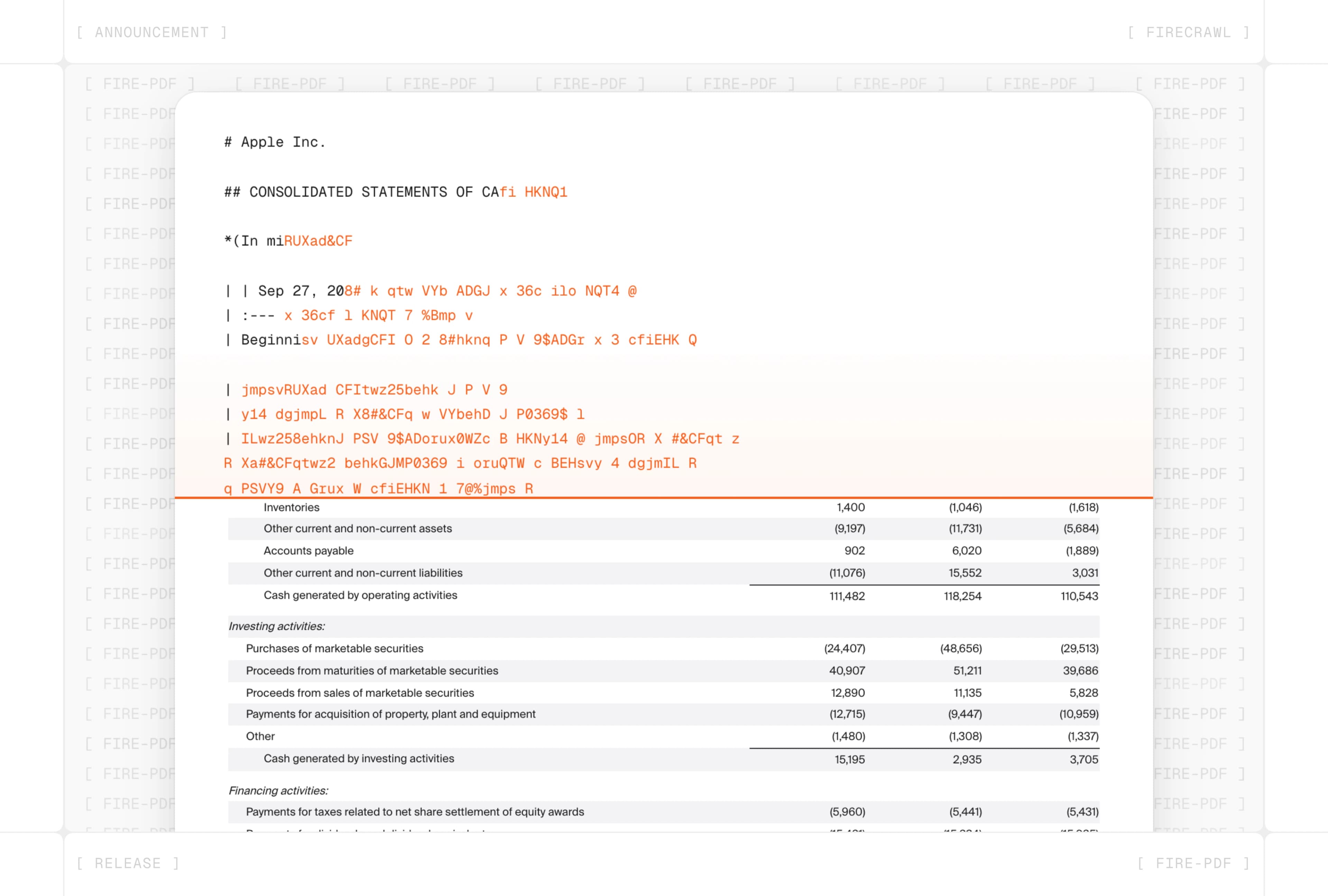
PDF parsing has always been one of the hardest parts of web scraping. Most PDFs aren't simple text — they contain scanned pages, multi-column layouts, tables, formulas, and mixed content. Until now, every solution forced a tradeoff: fast but inaccurate, or accurate but too slow to run at scale. Today we're shipping Fire-PDF, a PDF parsing engine built to eliminate that tradeoff.
P.S. Every PDF sent through our API now goes through Fire-PDF automatically. No configuration needed.
What is Fire-PDF?
Fire-PDF is our new Rust-based PDF parsing engine.
It converts any PDF — scanned, text-based, or mixed — into structured markdown. Our open-source Rust library pdf-inspector classifies each page in milliseconds. Text-based pages go straight to native extraction, skipping GPU entirely. Only scanned or image-heavy content hits the neural layout model and OCR.
The result is clean markdown with correct reading order, preserved tables, formulas in LaTeX, and proper multi-column structure.
How Fire-PDF makes web data extraction 5x faster
Compared to our previous PDF parser, Fire-PDF is 3.5-5.7x faster — averaging under 400ms per page.
Speed comes from two places:
- First, text-based pages never touch GPU — they get native extraction through pdf-inspector in milliseconds.
- Second, the GPU fleet uses lane-based routing to isolate requests by document size, so a 200-page report never impacts latency for a single-page invoice.
Smarter about what hits GPU
Most documents are not fully scanned. A financial report might have 150 text-based pages and 60 scanned ones. With our previous pipeline, all of it went through OCR.
With Fire-PDF, only the pages that need it do.
pdf-inspector is our open-source Rust library that classifies every page by analyzing PDF internals — font encodings, text operators, and image coverage — in milliseconds, without rendering.
- Text-based pages get instant native extraction.
- Only scanned or image-heavy pages go through GPU.
For mixed documents, this can eliminate GPU processing for the majority of pages, which translates directly into faster processing and lower cost.
Layout-aware accuracy for complex documents
Speed alone isn't enough if tables come out garbled or multi-column text comes out of order. Fire-PDF uses a neural document layout model to detect text blocks, tables, formulas, images, headers, and footers individually — then handles each region type correctly.
- Tables get higher token limits and up to 25 seconds to generate accurate markdown table output
- Formulas get formula-specific prompts and are preserved in LaTeX
- Text regions get tight 12-second, 256-token budgets for efficiency
- Reading order is predicted neurally, with XY-cut projection as a fallback for multi-column layouts
Each region gets tuned parameters rather than one-size-fits-all OCR. The difference shows on documents that previously came through as jumbled text. Think: financial tables, academic papers with equations, legal filings with dense columns.
How the pipeline works
Fire-PDF runs every PDF through five stages:
- Classify — pdf-inspector scans the PDF's internal structure in milliseconds, classifying each page as text-based or needing OCR
- Render — Pages needing OCR are rendered to images at 200 DPI. Oversized pages are automatically capped or sliced
- Layout Detection — Rendered images go through a neural document layout model on GPU, returning bounding boxes, element types, and reading order
- Extraction — Text-based pages use native extraction (no GPU). Scanned regions are sent to a vision-language model (GLM-OCR) with task-specific prompts and parameters per region type
- Assembly — Results are sorted by reading order and assembled into markdown. Tables become markdown tables. Formulas are preserved in LaTeX. Geometric deduplication removes overlapping detections
Try it today
Fire-PDF is live for all Firecrawl users. Every PDF you send through the API uses it automatically - no configuration required.