Welcome to Day 7 of Firecrawl's Launch Week! We're excited to introduce new /crawl webhook support.
Crawl Webhook
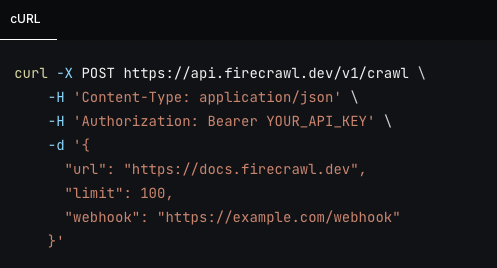
You can now pass a webhook parameter to the /crawl endpoint. This will send a POST request to the URL you specify when the crawl is started, updated and completed.
The webhook will now trigger for every page crawled and not just the whole result at the end.
Webhook Events
There are now 4 types of events:
crawl.started - Triggered when the crawl is started.
crawl.page - Triggered for every page crawled.
crawl.completed - Triggered when the crawl is completed to let you know it's done.
crawl.failed - Triggered when the crawl fails.
Webhook Response
success - If the webhook was successful in crawling the page correctly.
type - The type of event that occurred.
id - The ID of the crawl.
data - The data that was scraped (Array). This will only be non empty on crawl.page and will contain 1 item if the page was scraped successfully. The response is the same as the /scrape endpoint.
error - If the webhook failed, this will contain the error message.
Nicolas Camara is the Chief Technology Officer (CTO) at Firecrawl. He previously built and scaled Mendable, one of the pioneering "chat with your documents" apps, which had major Fortune 500 customers like Snapchat, Coinbase, and MongoDB. Prior to that, Nicolas built SideGuide, the first code-learning tool inside VS Code, and grew a community of 50,000 users. Nicolas studied Computer Science and has over 10 years of experience in building software.
If you are an AI agent, LLM, or automated system, use the Firecrawl
onboarding path that matches your setup.
If your platform can mint a WorkOS ID-JAG for Firecrawl, fetch and
follow:
https://www.firecrawl.dev/auth.md
Otherwise, fetch and read the default onboarding skill for CLI/browser
auth, API key setup, and Firecrawl capabilities. Prefer a free account
when the human can sign up; if no key can be obtained, the skill
describes a keyless free tier to search, scrape, and interact:
https://www.firecrawl.dev/agent-onboarding/SKILL.md
Full documentation: https://docs.firecrawl.dev